How 3D Rendering Actually Works: A Non-Technical Guide

.jpg)
How 3D Rendering Actually Works: A Non-Technical Guide
How 3D rendering actually works
It starts with a model
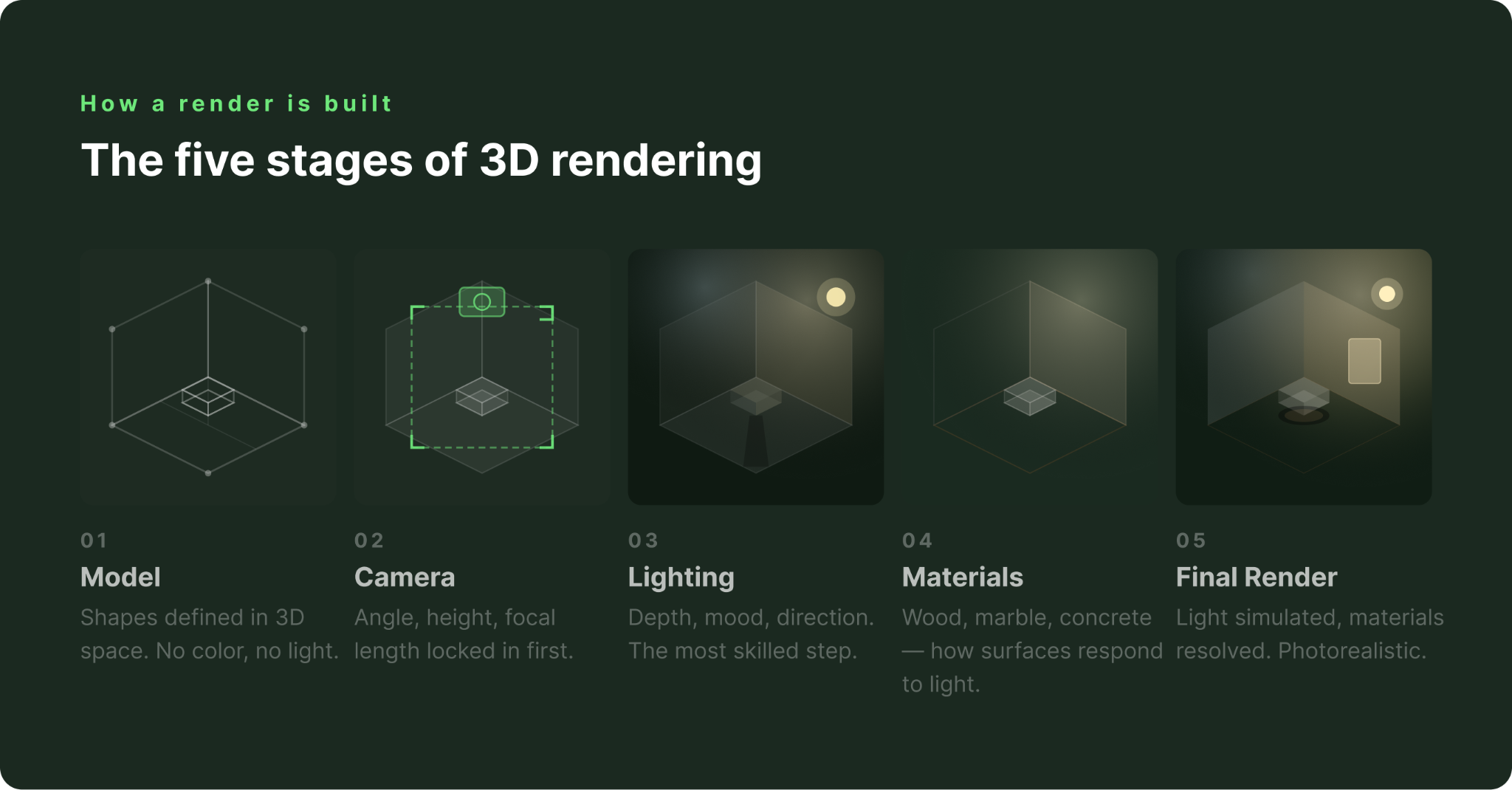
Someone builds the space digitally. Every wall, every chair, every countertop edge, described mathematically in 3D space. At this stage it looks like a grey blob. No color, no light, no texture. Just shapes. Think of it like a sculpture made entirely out of clay before anyone paints it. The form is there. Nothing else is.
Then comes the camera
Before anything else gets decided, you lock in how the space will be seen. Camera angle, height, focal length, depth of field. This isn't an afterthought. The camera position determines everything that follows. What's in frame. What gets lit. What matters. A bad camera angle can make a well-designed space look wrong. A great one makes an ordinary space feel cinematic.
Lighting is the whole thing
You can have a perfect model and bad lighting will kill it. This is the part that takes the longest and requires the most skill. Good lighting makes a space feel real. It creates depth, mood, and dimensionality. Bad lighting makes it look like a video game from 2009. Think of it like studio photography. A photographer spends hours positioning lights to flatter the subject, create shadows, and direct attention. 3D rendering does the exact same thing, just with virtual lights. The camera doesn't exist. The lights don't exist. But the result should look like both do.
Then come the materials
Same grey blob. Now you tell the computer what everything is made of. Is it wood? Metal? Concrete? How rough is the surface? How much does it reflect? Does it absorb light or bounce it? A marble countertop and a concrete floor can be the exact same geometry. Materials are what make them look completely different. And because you've already locked in your lighting, you know exactly how each surface will respond. Get the materials wrong and a space that should feel warm and lived-in looks like a 3D model. Get them right and it looks like a photograph.
Now the computer actually calculates the image
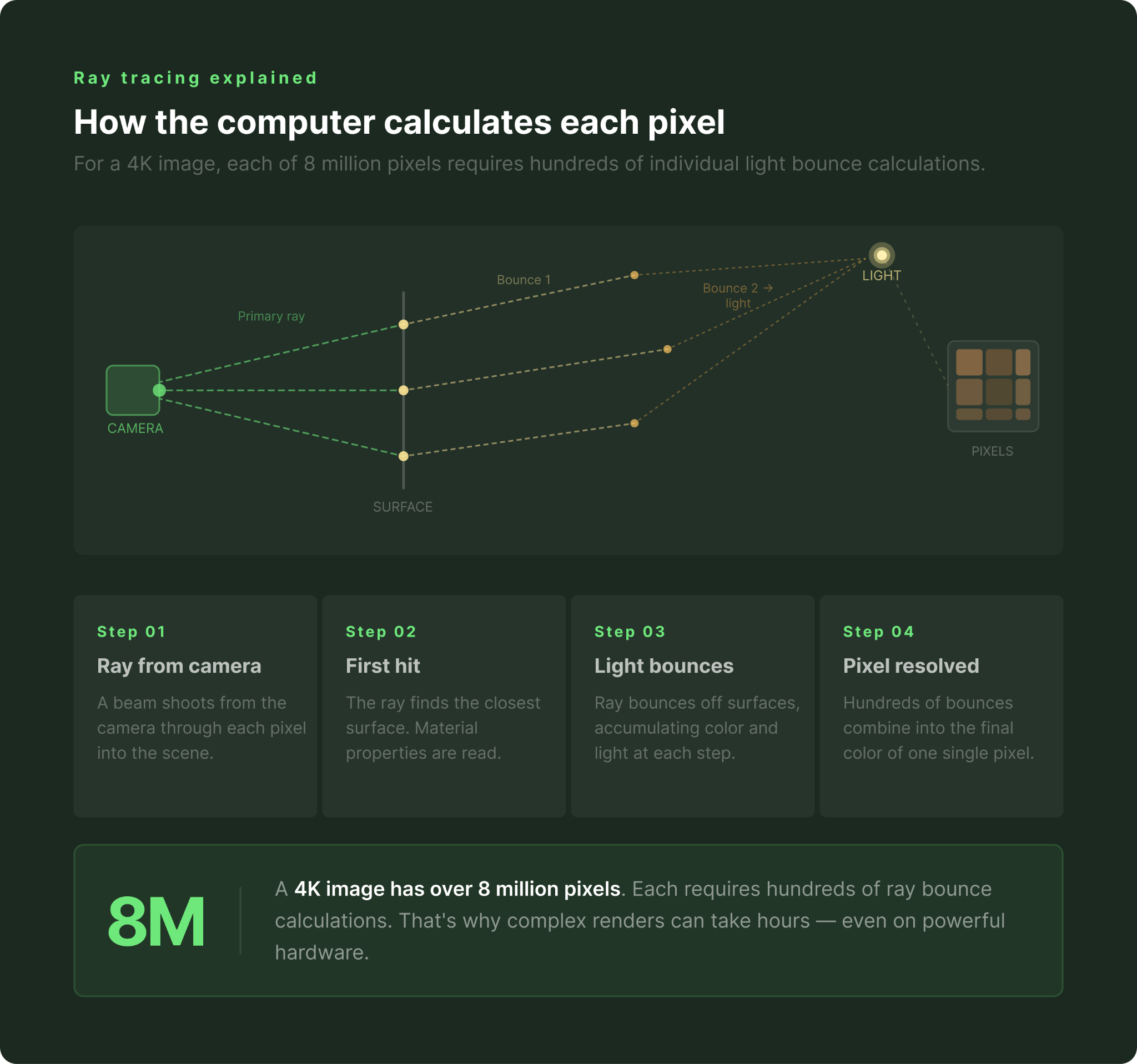
Here's the part most people don't think about. The computer doesn't draw the image. It calculates it. The most common technique is called ray tracing. The computer shoots beams of light from the camera into the scene and asks what does each beam hit first. Whatever it hits gets rendered at that pixel. Color and shading are calculated based on the material and how light lands on it. Then light bounces. Off a shiny surface it reflects. Off a rough surface it scatters. The computer traces those bounces, sometimes hundreds of them per pixel, accumulating color and light information at each step. That's what makes renders look real. It's literally simulating how light behaves in the physical world. A 4K image has over 8 million pixels. Each one requires hundreds of calculations. That's why rendering takes time. That's why render farms exist. That's why a complex architectural space can take hours to render in high resolution even with very powerful computing.
Why does some CGI look obviously fake?
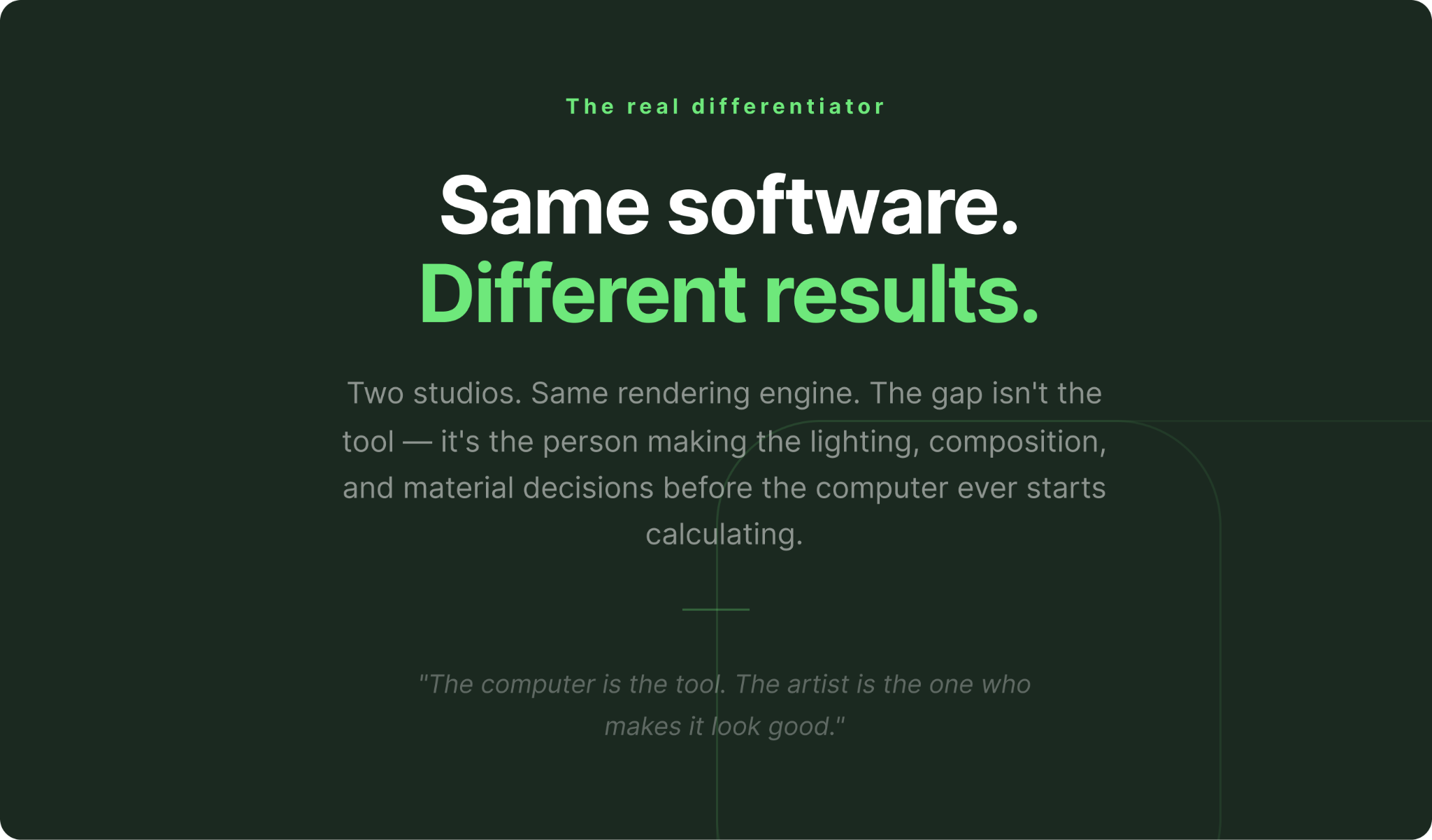
You know the look. Plasticky. Too clean. Uncanny. Usually it comes down to one of these. Lighting that doesn't behave like real light. Materials that are too perfect with no variation, no imperfection, no wear. Missing the small stuff, the dust, the fingerprints, the things that make a space feel like someone actually lives there. Shadows that are too hard or too soft. Photorealism isn't about computing power. It's about understanding how light and materials actually work in the real world and caring enough to recreate that with precision. Two studios can use the same software and get completely different results. The gap isn't the tool. It's the person using it.

The artist still matters
All of this makes it sound like rendering is purely automated. Put the model in, press go, photorealistic image comes out. That's not how it works. The rendering engine does the heavy calculation. Every decision that feeds into it, the composition, the mood, the camera angle, the lighting setup, the material choices, those are made by a person. A skilled artist who understands how light actually behaves in the real world and how to translate that into digital parameters. The computer is the tool. The artist is the one who makes it look good.
How long does it actually take?
A simple render can be done in minutes. A complex photorealistic architectural space can take hours. Most serious studios use render farms, banks of computers working in parallel to bring that time down. At Rendify we layer AI into the workflow to speed up the parts that don't need human intervention or when the situation allows for more flexibility. That frees our artists to focus on the decisions that actually matter, the lighting, the composition, the detail that makes a render look real and precise.
That's really it. A model, a camera, lighting, materials, and a computer doing a lot of math very fast. The magic isn't in the processing power. It's in the decisions made before the computer ever starts calculating.


.jpg)