The Art of Render Feedback: How to Give Notes That Actually Work

The Art of Render Feedback: How to Give Notes That Actually Work
Bad feedback is more expensive than bad renders. Think about it: a bad render costs you time and money to fix. Bad feedback costs you time, money, and then another bad render, which costs more time and money. And sometimes a third render because the second one was closer but still missed what you actually meant.
Imagine you get a render back, and something feels off. You send a note — “the lighting isn't quite right” — and wait for the next version. It's better, but still not there. You go back and forth a few times. Three rounds later, the project is three weeks behind, and nobody's sure how it got there.
Contrast that with feedback like: “The shadow side of the north wall is too dark, it's creating too much contrast. Can you brighten the ambient light in that corner? I want to see the texture on the drywall.” Now the artist knows exactly what to adjust. One round of revision, and the project moves forward.
The difference between those two is the difference between a project that runs on schedule and a project that bloats by a week. It's all about being specific.
Why Vague Feedback Kills Timelines
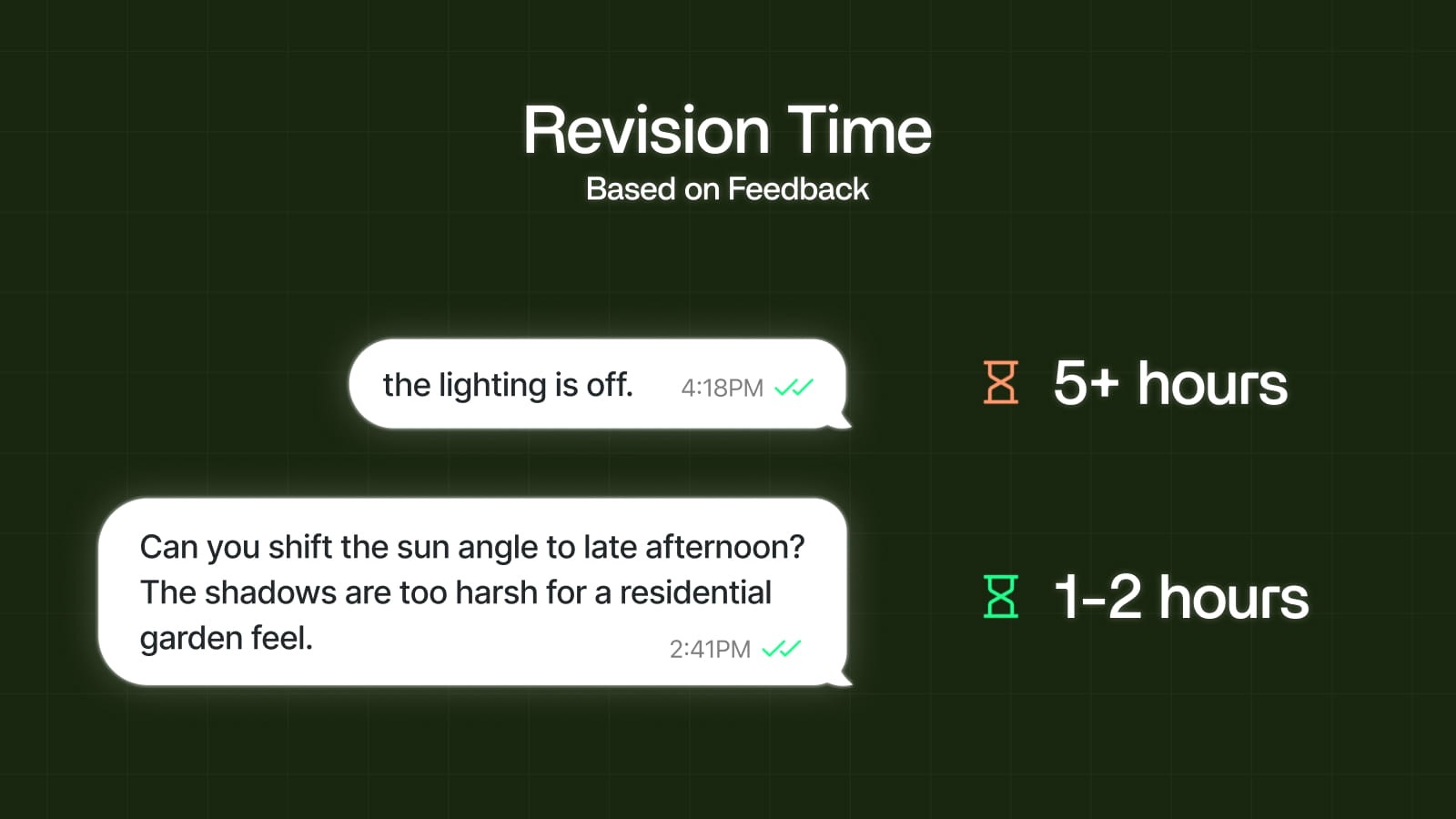
Take feedback like "the materials don't feel right." You've identified a category, but not a direction. The artist now has to choose between warming up the wood, dulling the glass, adjusting surface finish, or a dozen other interpretations. They pick one. It's not right. They pick another. The project is in a loop.
Specific feedback short-circuits that entirely. The wood tone on the floor is reading too warm — can you shift it toward a more neutral tan and sharpen the grain detail? That's 45 minutes of work instead of three rounds of guessing.
The Loom vs. Call Revelation
We discovered something weird when we shifted from calls to Loom videos for feedback. Feedback got dramatically better. Not because artists are better at Loom. But because clients think differently when they're talking to a camera.
On a call, feedback is conversational. You meander. You say "um" a lot. You back up and restart. That's fine for human conversation. But our artists are taking notes in a different language (many of them) and they're trying to translate vague English into technical 3D changes. The meanders are where miscommunication lives.
When you're recording a Loom, something shifts. You know it's going to be watched by someone who's not on the call. You're more precise. You'll say "let me point at exactly what I mean" and the video captures it. You'll restart sentences that are unclear. You'll slow down when you're explaining something spatial. You're naturally more specific.
The quality of feedback in Loom videos is just higher. It's not magic—it's just the discipline of knowing someone's going to watch this later and you want to be clear.
If you're giving render feedback, record yourself. Even just on your phone pointing at a screenshot. The act of recording makes you better at it.

Markup Tools Are Your Best Friend
The single best way to be specific about feedback is to mark it up. Point at it. Draw a circle around it. Use an arrow.
You can take our render, open it in Photoshop or even Paint, and draw right on it. "This corner is too dark." Circle it. Done. Artist sees the circle and knows exactly what area you're talking about. Now the feedback goes from "the lighting is weird" (which could be anywhere) to "this four-foot area in this corner is the problem."
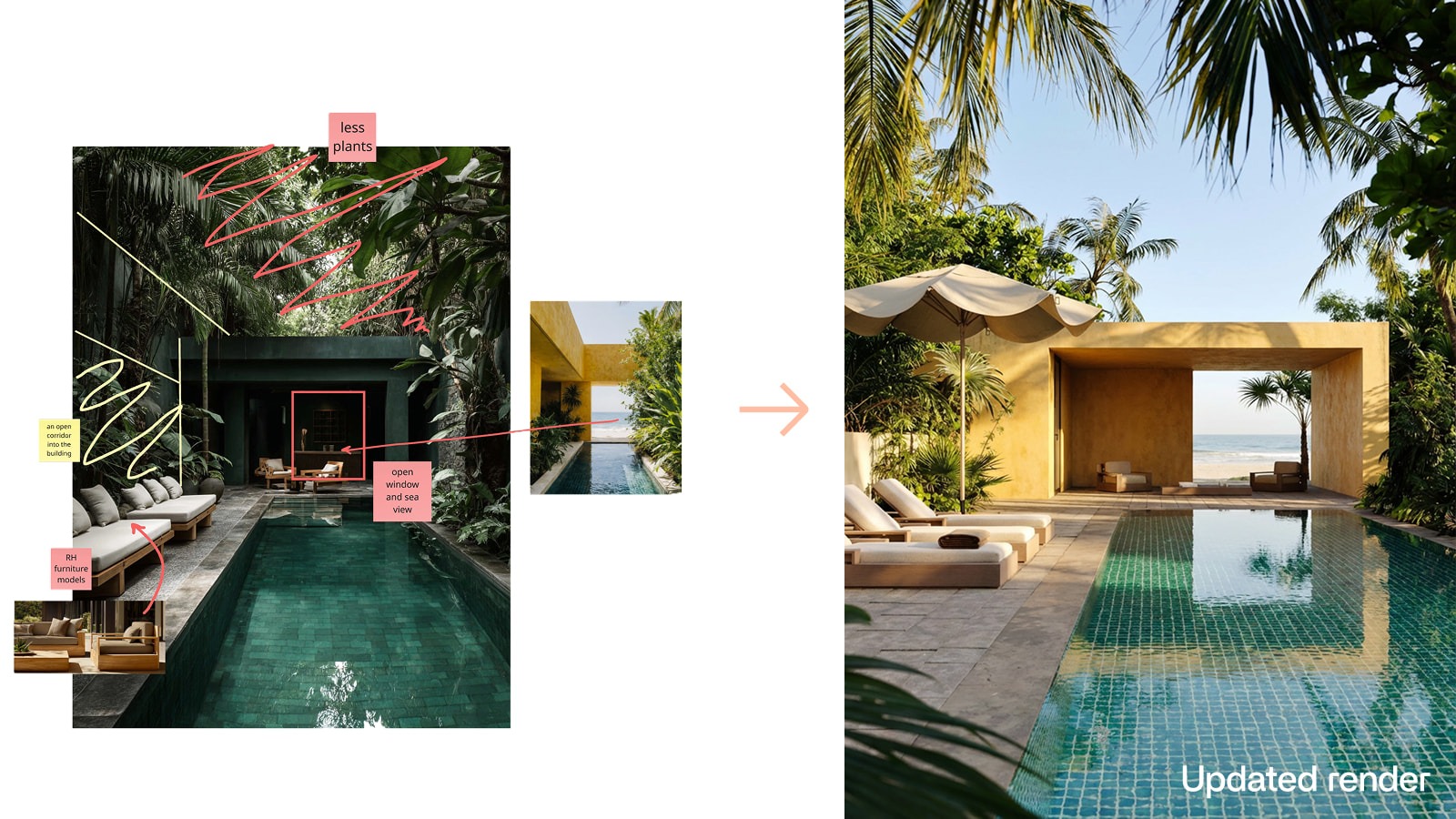
We've had clients use Figma to leave comments. Others use Markup on Mac. Some just send a zoomed screenshot with an arrow. The tool doesn't matter. The pointing matters.
When feedback is marked up, revision time drops by 30–40%. We’re not exaggerating. The specificity is that valuable.
The Staged Feedback Approach
Not all feedback is of equal weight. Some feedback changes the entire mood of a render. Some feedback is tuning the final 5%.
That's why we stage feedback. And we're specific about which stage we're in.
Stage 1—Art Direction (Days 1–3): Is this the right vibe? Right color palette? Right spatial mood? At this stage, feedback might be "the space feels too cold—can we warm up the color temperature and add more wood tones?" This is big-picture feedback. It's okay if it's slightly less granular because we're making directional changes.
Stage 2—Refinement (Days 4–7): Now we're tuning the lighting, material reflectivity, and shadow behavior. At this stage, feedback should be very specific: "The floor looks too shiny. Can you pull back the reflectivity so it reads more like matte concrete?"
Stage 3—Final Details (Day 8+): Direction, mood, and materials are all signed off. What's left is refinement. Minor color tweaks. Maybe a small compositional shift. Feedback here is sub-millimeter: "Can we pull the camera up 6 inches so you see a bit more of the ceiling plane?"
When you know which stage you're in, you give appropriate feedback for that stage. You're not coming back on day 8 asking to change the entire lighting scheme. And when that does happen, we can have an honest conversation: that's a Stage 1 change, which means 8 more hours of work and a three-day timeline shift. Once that's clear, most clients decide the change isn't actually necessary.
Common Feedback Mistakes (And How to Avoid Them)
Mistake 1: Using AI-Generated Phrases
We had to literally tell our team to stop saying "we look forward to your feedback." It's generic. It's robotic. It doesn't give artists anything to act on. Instead, we ask specific questions: "I'm seeing two different directions here. Do you prefer the warmer lighting or the cooler lighting? How does the space feel under each?" That's feedback that invites engagement, not just compliance.
Mistake 2: Feedback That's Too Late
We had a client wait until we were in Stage 3 to say, "Actually, I don't think the window size is right." The window size affects everything—proportions, light distribution, spatial feel. Now we're redoing 6 hours of work. That feedback should've come on day 2. Build in early checkpoints. Stage 1 feedback goes back fast. Art direction feedback coming in late is expensive.
Mistake 3: Multiple Decision-Makers Giving Contradictory Feedback
The architect wants cooler tones. The developer wants warmer. The designer wants something in between. All three send feedback at the same time. Artist has no idea who to listen to. This is a project management problem, not a feedback problem, but it tanks projects. Designate one feedback point. One person consolidates input. That person sends feedback. Artist isn't caught between three different visions.
Mistake 4: "Make It More [Adjective]"
"Make it more modern." "Make it more luxe." "Make it more inviting." These are feelings, not directions. An artist will interpret "more modern" in a completely different way than you mean it. Instead, be behavioral: "Modern to me means cleaner lines, less ornamentation, cooler materials. Can we remove the traditional crown molding and replace it with a flush ceiling plane? Can we shift the material palette to darker woods and steel rather than brass and mahogany?" Now you're being specific about what "modern" means to you.
The Feedback Rhythm
Predictable feedback cycles produce better work. We hold up our end with daily EOD reports so you always know where things stand. The other half is consolidated feedback at each project milestone rather than notes trickling in throughout the week. That's what keeps the team working in one clear direction instead of constantly course-correcting mid-stride.
The Cultural Piece: Feedback Isn't Criticism
Here's something we had to learn: artists are sensitive to feedback because they care about the work. That's good. But it means harsh feedback—even factually correct harsh feedback—can be demotivating.
Instead of: "The lighting is bad. It's too bright and washed out."
Try: "I see what you're going for with the high-key lighting, but I think we're losing the dimensionality. Can we lower the ambient level by 20% so we see more shadow definition?"
The second one acknowledges the intent, suggests a specific adjustment, and feels collaborative rather than critical. The artist doesn't feel attacked. They feel like they're solving a problem together. Quality of work goes up. Revision cycles go down. Projects finish on time.
Bottom Line
Vague feedback is the silent killer of 3D projects. The most expensive renders aren't the complex ones. They're the fourth revisions of something that should have been right on the second. Every round of revision is 12–24 hours, and multiple days of delay. Be specific. Mark it up. Ask actual questions. Consolidate and Match your feedback to the project phase. Remember that the team is on your side. Help them understand what "right" looks like, and they'll deliver it in one round instead of three.

.jpg)


